Signed in as:
filler@godaddy.com
Recently, one of the staff historians from the Staunton Historic Society conducted research on the Spotts-Coffman house, and we are very pleased with the results. We will share some findings on this website and inform visitors during our house tours. Our first episode is below.
Big and Little Kalorama
The Spotts-Coffman house is situated on land that was once part of the Kalorama estate, which included a manor house and additional outbuildings established in 1756. By 1771, this estate was owned by Patrick McDavid, and in 1806, it was sold to Daniel Sheffey, who named the manor house "Kalorama," a Greek term meaning "fine view." Perched on a hill in what is now the Gospel Hill historic district, the manor house must have offered a stunning vista before the property was subdivided into building lots. Although the house still stands, it has undergone extensive modifications over the years; it was once the city library of Staunton and most recently served as a private high school, situated directly across from the Hotel 24 South in Staunton.
After Sheffey's death in 1830, the Kalorama manor house was transformed into a boarding school for young women, with his widow Maria and their five daughters at the helm. This institution was the first of its kind in Staunton, eventually becoming known as the Virginia Female Institute and paving the way for the Stuart Hall Academy.
Around 1860, one of the daughters, Margaret, a widow caring for a disabled daughter, decided to construct a house on the property. Shortly thereafter, her unmarried sister Ann Louisa moved in with her. This new residence became known as "Little Kalorama" and laid the foundation for what is now the Spotts-Coffman house. In 1873, the sisters sold the house and its subdivided lot to Henry P. Dickerson, who referred to the residence as "New Kalorama." The names were used interchangeably over the years.
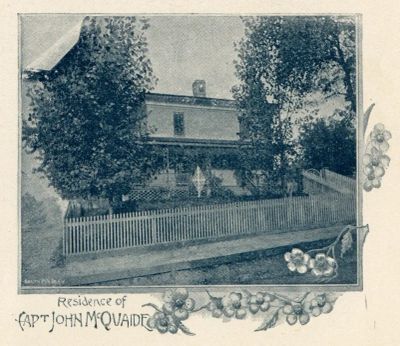
Henry, a farmer based outside of Staunton, operated the Kalorama house as a boarding house during the 1870s and 1880s. Unfortunately, financial difficulties forced him to place the house for sale in 1885. Although it was advertised as having eight rooms with gas and water upstairs and down, along with a stable and usual outhouses in good repair, the house failed to sell by 1886. Ann Sheffey, as the mortgage holder, sued Henry, leading to the house and land being auctioned in 1887, where John McQuaide emerged as the winning bidder.
Known as "Captain McQuaide" for his service to the Confederacy, John married Sarah McMahon in 1874 and joined his father-in-law's dry-goods business. He later invested in James Bumgardner's Distillery, famous for producing wines, liquors, and rye whiskey, which enabled him to purchase the house.
Active in various organizations in Staunton, McQuaide played a significant role in replacing dirt roads with brick paving and founding a paid fire department. The McQuaide family had seven children, but only three survived after both parents died months apart in 1899. The three surviving children—John, Frances, and Raymond—were still young and had guardians appointed. While the fates of John and Frances remain unknown, Raymond was placed with an elderly relative in nearby Rockingham County. By 1910, he was working as an electrician in the motion picture industry in Norfolk, Virginia.
Due to debts from the McQuaide estate, the house was put up for auction again, and "Little Kalorama" was purchased by John M. Spotts in September 1900. The Spotts family, including their only child Charlotte, held onto the house for eighty-eight years. The details of their experiences and any changes made to the home will be explored in another episode, which you can access by clicking here.